
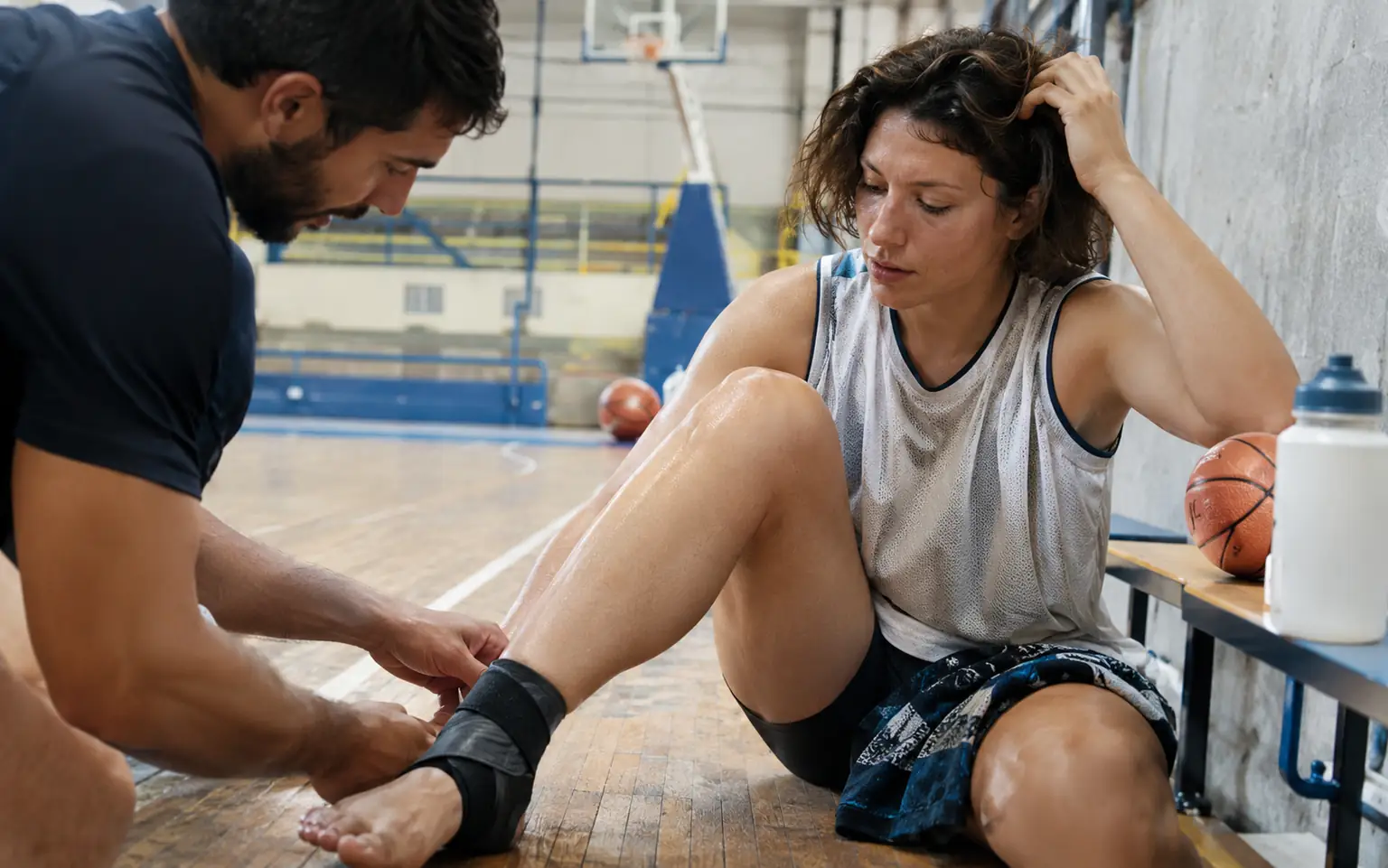
A dressing room can go on without you. There are still training sessions, team photographs, tactical meetings and match reports. Your name, once called every week, may no longer appear on the sheet. The injury itself may have happened in seconds; its quieter consequences arrive slowly, as familiar routines move on and you watch from elsewhere.
Ask an injured athlete when they will return, and you may receive a date, a shrug or silence. Ask who they feel they are while they cannot compete, and the conversation can become much harder. Sport gives people a language for belonging. It gives shape to their days, their friendships and their sense of usefulness. An injury can interrupt all of that long before a doctor signs a return-to-play form.
The psychological impact of injury is not evidence that a person lacks discipline. It can reflect the sudden loss of familiar routines, close relationships, confidence in movement and an identity that has become central to everyday life. Even a minor injury can feel destabilizing when a young athlete fears losing a place on a team. A more serious injury can expose practical pressures around contracts, education, family income or selection.
Recovery therefore has at least two connected tracks: physical healing and the rebuilding of trust in oneself, one’s body and one’s environment. These tracks influence each other, but neither follows a simple calendar. Different injuries and different people require different care. The goal is not to make every athlete feel positive every day. It is to help people move safely through uncertainty without being reduced to the injury.
The empty space where the routine used to be
A typical training week can structure an athlete’s entire life. There are hours to arrive, people to see, equipment to prepare and small goals against which progress can be felt. Remove training abruptly and the day may feel oddly shapeless. Even enjoyable activities can seem less meaningful when they no longer connect with the familiar identity of “being an athlete.”
Friends may continue preparing for matches while the injured person attends appointments or sits at home. Messages can become less frequent. A well-meaning coach may assume that the athlete needs privacy when they actually need ordinary contact. The result can be a social injury layered on top of a physical one: not only can the person not compete, but they can also feel that their place in the group is becoming uncertain.
A good recovery plan includes connection as well as exercise. That might mean joining selected team meetings, contributing to tactical review, attending social activities or mentoring younger players—if the athlete wants to do so. Involvement should not become an obligation to remain cheerful. Being included means having a choice and a meaningful role, not serving as a motivational mascot.
Identity is more than a label on a medical chart
The 2025 systematic review “Athletic identity and sport injury” draws on qualitative studies examining the ways injuries change athletes’ sense of self. That perspective matters because an injury is not experienced solely as a damaged tissue. It can also affect the stories people tell themselves: “I am dependable,” “I am fast,” “I am the one who never misses a match.”
When that story becomes temporarily impossible, an athlete may interpret normal limits as a personal failure. A player who cannot sprint may think they have lost their character, not just their speed. A gymnast who must avoid impact may feel that all the years of preparation have stopped counting. Nobody needs to agree with these conclusions for the feelings to be real.
Support should separate what the body can currently do from what the person is worth. Physical rehabilitation can restore function over time; psychological support can help someone recognize that commitment, curiosity, loyalty and courage have not disappeared. Broadening identity is not a demand to care less about sport. It is an invitation to remain a whole person while sport changes.
The promise and trap of a return date
Athletes, families and coaches often ask the same question immediately after diagnosis: when can they play again? A date can provide hope, coordinate schedules and organize treatment. But recovery is not a railway timetable. Tissue healing, strength, movement quality, readiness and sport-specific demands may progress at different speeds.
A deadline becomes dangerous when it turns from an estimate into a moral test. A player may hide discomfort to avoid disappointing others. A teenager may compare progress with someone recovering from a different injury. A club may describe a delay as “lack of effort” without understanding what the clinician is measuring. These pressures can make honest communication harder at precisely the moment it matters most.
Return decisions should be made by appropriately qualified professionals using the athlete’s individual presentation and the requirements of the sport. Coaches can support by asking what activity is currently approved and by avoiding pressure to accelerate medical clearance. Families can help by treating a revised timeline as information, not failure. Clarity is valuable; false certainty is not.
Fear of reinjury is a real part of performance
An athlete can regain measurable strength while still hesitating before a tackle, landing or change of direction. This is sometimes misunderstood as a simple lack of courage. Yet a previous injury can change the meaning of a movement. The brain is responding to a remembered threat, even if the body is making good physiological progress.
The 2019 IOC consensus discusses emotional responses to injury and strategies that may help return-to-sport experiences, including autonomy in rehabilitation, progressive functional goals and social support. A 2026 systematic review of psychological determinants in competitive athletes found that readiness measures showed useful predictive associations with returning to sport, especially in research on anterior cruciate ligament injuries. Associations are not guarantees for individual patients, and different tools have specific limitations.
For some athletes, observing successful safe movement, practicing graduated tasks and understanding the purpose of each stage can help rebuild trust. These are activities to integrate with the rehabilitation team, not internet prescriptions to perform alone. The best question is often not “Are you fearless yet?” but “What can you do safely today, and what evidence would make the next step appropriate?”
Not every difficult emotion is a disorder
Sadness, irritability, frustration, envy and fear can be understandable reactions when a valued activity stops. They do not automatically imply a clinical diagnosis. Equally, serious symptoms should not be ignored because the athlete is famous for toughness. The distinction depends on severity, duration, impairment, personal history and appropriate assessment.
The IOC’s 2026 mental-health consensus recommends routine screening and monitoring with validated tools in elite sport. That reflects a need for systems, not guesswork. Clubs should understand whom athletes can approach, what safeguarding obligations apply, and how referrals to licensed clinicians work. Coaches should avoid telling athletes that injury-related distress is “all in the head,” but they should also avoid diagnosing depression in a corridor.
The practical approach is humane and precise. Listen, ask what support is available, recognize warning signs and refer when necessary. An injured athlete deserves privacy and agency. They also deserve a clear explanation of what can and cannot be kept confidential where safeguarding duties are involved.
Rehab should produce understanding, not blind obedience
Rehabilitation can feel repetitive and slow. An athlete may be asked to perform movements that appear unrelated to the sport they love. Without explanation, exercises become a tedious ritual; with context, they become evidence of progress toward a larger purpose.
A physiotherapist might describe why a particular strength or control task matters before higher-speed work. A coach might explain how the eventual training environment will be adapted. A sports psychologist may help address responses to setbacks or uncertainty, within the boundaries of their competence. The aim is a coherent team, not three professionals giving the athlete contradictory instructions.
Athlete autonomy matters. There can be meaningful choices about preferred exercise settings, ways to record progress and how to communicate with the team. Not every medical decision is negotiable, but understanding why a limit exists can make it easier to accept. A person who understands the plan is better positioned to report changes honestly.
The coach’s language can either heal or isolate
“You will come back stronger” is a familiar phrase. Sometimes it feels encouraging. Other times it can sound like a demand to turn pain into an inspirational story before the athlete has had time to absorb what happened. Not every injury creates an extraordinary comeback. Some people recover fully, others need to adapt, and some careers change direction.
Better language leaves room for the actual experience. “We want you here even while you cannot play.” “Tell us what involvement feels useful.” “Your medical team decides the progression; we will support it.” These sentences do not promise a result they cannot control.
A coach also needs to manage the team’s response. Teammates may be unsure what to say or may avoid the injured player out of awkwardness. Simple normal contact can matter. Invite without insisting. Include without pity. Speak about the person’s interests outside the injury. The strongest culture is not one that turns every setback into content; it is one that preserves belonging when performance disappears.
Young athletes face particular pressures
For a teenager, injury can happen during an examination year, a growth spurt or an important selection window. They may be worried about friends moving into an older squad while they remain behind. Adults can underestimate these concerns because the event seems minor compared with adult professional competition. To the young person, it may represent an entire immediate world.
Parents often carry their own anxiety about investment and opportunities. They can unintentionally transmit that anxiety by repeatedly asking about the return date, new scans or whether the coach still remembers their child. A useful alternative is to ask what would make the coming week more manageable: transport, company, a different social activity, or simply fewer conversations about sport.
Young people should remain involved in age-appropriate decisions about their care, with appropriate clinical and safeguarding support. Their privacy and wishes matter. Rehabilitation is not an audition in which a child has to prove adult resilience.
Returning to the team is not the end of recovery
There is a temptation to consider the story finished the first time an athlete appears in a competition again. But the return can introduce new pressures: comparison with pre-injury performance, fear of letting the team down, changed selection status and uncertainty about future pain. A technically cleared athlete may still be learning to trust specific movements.
Teams should keep communication open after formal return. Did the athlete understand the planned minutes? Did the competitive demands differ from rehabilitation? Was recovery time adequate? Was feedback about performance respectful? Psychological readiness, physical function and practical match demands may need repeated review rather than one ceremonial clearance.
If a player later needs to reduce load or revisit a stage, that adjustment should be treated as information. The ultimate objective is not merely to produce a dramatic return photograph. It is to support sustainable participation and long-term health.
A recovery checklist for teams and families
- Preserve belonging. Ask the athlete how they would like to stay connected, and make inclusion possible without requiring attendance at every event.
- Use qualified assessments. Make medical clearance and rehabilitation progression individual rather than based on comparison with another athlete.
- Protect honest reporting. Never make someone fear punishment for reporting pain, hesitation or distress.
- Track more than dates. Discuss function, confidence, participation, education, social contact and rest.
- Support a wider identity. Encourage interests, friendships and roles that are not dependent on immediate competitive success.
- Agree who communicates. The coach, clinician, athlete and family should know what information can be shared and with whom.
These are organizational prompts, not a substitute for professional treatment. They are also a test of culture. A team can speak about loyalty when everyone is scoring. The more revealing moment is when one person cannot play.
What recovery can teach a sporting community
The point of supporting injured athletes is not to manufacture a moral lesson from their suffering. Nobody owes an audience a comeback story. But injury can reveal what a sports system really values. If belonging depends entirely on availability, the institution may be using rather than supporting its participants.
A more mature approach accepts uncertainty. Some athletes return quickly; others take longer. Some choose another role or another sport. The outcome should be understood in the context of health, personal choice and opportunity, not simply measured against the original return date.
When a team cares for its injured members, it makes an important statement to everyone watching: you matter here before and after your next performance. That promise can outlast a season, a result and even a sporting career.
A hypothetical season: the athlete who is still part of the team
Consider a young goalkeeper who injures a knee early in the season. Initially, teammates send frequent messages. After several weeks, ordinary life continues and the player is no longer present at most training sessions. The goalkeeper begins to worry that the club has moved on. This is a hypothetical situation, not the biography of a real athlete, but it illustrates how physical absence can become social uncertainty.
A coach could respond with a simple plan agreed with the player: a weekly check-in, invitations to selected tactical discussions and appropriate opportunities to remain involved without pressure. The medical team determines which physical tasks are safe. The goalkeeper chooses how much contact feels useful. Nobody promises a return date that cannot yet be justified.
As recovery progresses, the plan changes. There may be days when involvement helps and days when it is exhausting. The player should be allowed to say so. This flexibility is the difference between treating inclusion as a publicity gesture and treating it as an ongoing relationship. The club learns to communicate with the person, not merely with the injury report.
What a rehabilitation team should agree on
Different professionals may evaluate progress from different perspectives. A physician considers diagnosis and medical risk. A physiotherapist assesses movement, capacity and graded activity within their scope. A coach understands specific competitive demands. A qualified psychological professional may help with emotional distress, fear, identity disruption or mental-health needs. Their contributions should be coordinated rather than arranged as competing authorities.
The athlete should know who makes return-to-play decisions, how disagreements are handled and what information may be shared. A coach might legitimately need to know that a player cannot participate in contact training; they do not automatically need confidential details from psychotherapy. Similarly, a family may need general guidance without receiving information an adult athlete has not authorized them to access.
Written communication can be brief but specific. Rather than circulating vague statements such as “almost ready,” teams can document approved activity categories and review dates. This reduces confusion and protects the athlete from being asked to exceed an agreed stage simply because someone misunderstood the plan.
The period after return deserves its own support
A first match back may be emotionally significant, but it is not the same thing as the end of adaptation. Opponents move unpredictably. Competitive speed may exceed rehearsal speed. The athlete might notice hesitation, fatigue or heightened attention to the previously injured area. These reactions should be discussed with qualified staff rather than interpreted automatically as mental weakness.
Teams can schedule follow-up conversations after several sessions and competitions. Ask how the athlete understood the demands, whether any movement remains uncomfortable, and which adjustments are clinically appropriate. Review playing time, recovery and confidence without assuming that a single score captures readiness. When concerns arise, the plan may need to change.
An organization that celebrates the comeback photograph but disappears afterward has confused an event with a process. Sustainable rehabilitation includes the months in which an athlete learns how to compete again, not only the day their name returns to a lineup.
Education and work should not disappear during recovery
For many young people, sport shares space with school, employment, apprenticeships and family responsibilities. Injury can alter those responsibilities. Appointments may clash with examinations; reduced training may create time that feels strangely difficult to use; a professional athlete may worry about a contract or income. A plan focused only on exercises can miss these realities.
A conversation about education and practical life need not diminish ambition. It can help preserve stability. Clubs can coordinate appointment information, consider reasonable scheduling adjustments and direct families toward trustworthy advice about contracts or insurance when relevant. They should avoid implying guarantees about coverage without examining actual terms.
Athletes also deserve the freedom to use recovery time differently. Some will find education or volunteering restorative; others will need rest and space. The goal is not to fill every hour with productivity. It is to prevent the loss of one role from being mistaken for the loss of an entire future.
Why a successful outcome may look different from the original dream
Not every athlete returns to the same level or sport. Some adapt their participation, switch disciplines or decide that their priorities have changed. These choices should not be romanticized as universally positive, nor judged automatically as failures. Circumstances differ, and difficult medical realities can limit options.
A respectful sports organization can support transitions even when they do not lead back to the original team. That may involve introductions to community activities, education, coaching pathways or other interests. Athletes should receive accurate information and retain agency over decisions affecting their lives.
There is an important ethical difference between celebrating resilience and demanding it as a performance. Recovery is not an audition to prove loyalty. When people are treated well through uncertain outcomes, the club demonstrates a standard of care stronger than any comeback slogan.
The moment the athlete belongs again
A return to sport should not be treated as a ceremony that occurs only when medical clearance is signed. Belonging can begin much earlier: an injured player might attend tactical meetings, contribute an observation, stay connected to teammates, or discuss goals with the rehabilitation team without being pressed to perform. These opportunities must be offered, not imposed. Some athletes need distance from the team while symptoms are difficult; others find connection protective. The principle is choice within a clinically safe plan.
Coaches and medical staff should agree on who communicates progress, what uncertainty remains, and which activities are permitted. An athlete should never be required to exaggerate confidence in order to preserve a place. After full return, the first sessions may feel psychologically unfamiliar even if physical tests are satisfactory. Listening at that moment is not an indulgence: it is part of noticing whether rehabilitation has prepared the whole person for the demands of the sport. A successful comeback is safer and more sustainable when the athlete feels informed, respected and included.
From the Legends archive: when changing sport changes the future
The career of Dutch cyclist Harrie Lavreysen offers an unusually clear example of sporting identity being rebuilt. His early ambitions were in BMX, where he won major youth titles. Repeated shoulder injuries led him away from that discipline; in 2015 he moved to track cycling and developed a different elite career. This is not a universal comeback formula, nor a reason to pressure an injured athlete to reinvent themselves. It is one documented example of how a career's direction can change without erasing everything learned before it.
The lesson for a rehabilitation team is neither “return stronger” nor “find a new sport.” It is to preserve choices, recognize loss and help an athlete work with what is medically and personally possible. For the everyday psychological side of competition, read The Mind Is Part of the Athlete.
Evidence context and limits
Liu, Noh and Kim (2025) synthesised qualitative studies of athletic identity after injury. Rajpoot et al. (2026) reviewed psychological readiness and return-to-sport research. Neither source replaces an athlete-specific medical assessment or supports a guaranteed comeback timetable.
Research and further reading
- Liu, S., Noh, Y.-E., & Kim, J. (2025, online). Athletic identity and sport injury: A systematic review and meta-aggregation. BMC Psychology, 14, article 111. DOI: 10.1186/s40359-025-03902-7. Original source
- Reardon, C. L., et al. (2019). Mental health in elite athletes: International Olympic Committee consensus statement (2019). British Journal of Sports Medicine, 53(11), 667–699. DOI: 10.1136/bjsports-2019-100715. Original source
- Reardon, C. L., et al. (2026). Mental health in elite athletes: International Olympic Committee consensus statement (2026). British Journal of Sports Medicine, 60(15), 1083–1130. DOI: 10.1136/bjsports-2025-111514. Original source
- Rajpoot, Y. S., et al. (2026). From slump to comeback: Psychological determinants of performance decline, burnout, and recovery in competitive athletes—A systematic review. Sports, 14(5), article 165. DOI: 10.3390/sports14050165. Original source
*Editorial note: This is an evidence-informed educational feature. Hypothetical situations illustrate common dilemmas and are not reports about identified athletes. Medical and psychological decisions require qualified individual assessment.*
Editorial illustration using an original Sportive Minds photograph featuring fictional people; not documentary reporting or endorsement.