
Volleyball / Opposite hitter
Andrea Zorzi
A teenager once embarrassed by his own height found a place where it could become a strength. He was sixteen when volleyball entered his life; years later, the world would know Andrea “Zorro” Zorzi as one of the most formidable attackers of Italy’s Generazione di Fenomeni. The numbers are immense: 325 appearances in blue, two world titles, three European crowns, three Olympic Games and silver at Atlanta 1996. But the story begins before the victories and continues long after the applause. Zorzi has spoken openly about the cost of relentless competition, the difficulty of defeat and the danger of dividing human beings into winners and losers. Athlete, teammate, storyteller and stage performer, he offers something more valuable than the fantasy of an invincible hero: the example of a person who learned to turn discomfort into belonging, excellence into shared work, and an ending into a new beginning.
A fuller biography: the person behind the results, the world they grew up in, the decisions they made, and the legacy left beyond competition.
The early years: family, home and childhood
Before the national-team jersey, before the crowded halls, there was a boy who did not yet know what to do with his height. Andrea Zorzi has described adolescence as a period in which being unusually tall made him uncomfortable. The body that others might have considered an advantage initially felt like something that marked him out.
He grew up in the Veneto, attended a classical high school, and did not come to volleyball as a child prodigy moving along a carefully mapped career path. In accounts given years later, he explained that a physical-education teacher suggested he try sport; basketball and volleyball were possibilities. The volleyball gym was closer to home. That practical detail, almost comically ordinary beside all the titles that followed, matters: the turning point in a life does not always announce itself.
Zorzi was sixteen when he began. In interviews he has said that being among other tall people helped him feel more comfortable, less conspicuous. Volleyball offered more than a place to develop a jump or a powerful arm. It offered a setting in which something he had experienced as a weakness could become a strength, and where he could belong without first changing who he was.
The early story is not a fairy tale in which insecurity magically disappears. It is an account, told by the athlete himself, of how finding the right environment can change the meaning of a personal difficulty. Before talent is measured, a person must sometimes discover a place where that talent can breathe.
Growing up in a changing world
The Italy Zorzi entered was not yet the seemingly inevitable volleyball giant that later generations remember. Club competitions in the 1980s and 1990s were fiercely contested, professional standards were rising and the national side was preparing to challenge the sport's established powers. These were years when television, sponsorship, coaching innovation and international competition were changing the scale of the game.
His development through Padua and Parma placed him inside that transformation. At the elite level, exceptional physical attributes were only a beginning. An attacker had to learn to read an opponent's block, move in time with a setter, adapt after errors and return to demanding training the following day. Those requirements did not disappear when trophies arrived. Excellence has the difficult habit of becoming the new minimum expected of a champion.
With Parma, the 1990 Grand Slam showed what was possible when a squad could reproduce its best work across different competitions and countries. With the national team, the same generation would carry Italian volleyball into a new era. Its players became household names. To those watching from the outside, greatness could look effortless; to those living inside a championship team, it required continual adjustments, shared responsibilities and sustained concentration.
This is where the metaphor of a parallel world is useful, provided it does not become mythmaking. Elite athletes practise in conditions most people never experience, but their questions remain recognisably human: What must I change? Who can I trust? How do I contribute when it is not my turn to shine? What happens after I fail?
The people and relationships behind the career
No volleyball attack exists without the work that precedes it. Someone receives the serve; someone creates the set; another player covers the space that opens. Even a spectacular finish is the visible end of an invisible sequence of cooperation. Zorzi's national team became an extraordinary demonstration of this truth.
In later interviews he has resisted the romantic idea that a winning team is necessarily a family of inseparable friends. His recollections include pressure, disagreements and strong personalities. At Giffoni in 2024 he emphasised respect: people can be different, and even disagree deeply, while still doing excellent work together. He spoke about the relationships formed with fellow players and the fact that a shared purpose does not require identical opinions.
That distinction matters. Respect is not the absence of conflict. It is what allows people to continue working together when conflict is real. Under Julio Velasco, Italy combined outstanding individuals — among them Lorenzo Bernardi, Andrea Giani, Andrea Gardini, Luca Cantagalli and many others — into teams capable of winning repeatedly against the world's best.
Zorzi has also described the schoolteacher whose advice led him towards volleyball and the coaches who recognised promise before it was fully formed. In a 2024 interview he recalled the Polish coach Aleksander Skiba, who later told him that his visible embarrassment after mistakes had signalled how much he cared. The story should not be polished into a rule that every mistake is noble. Its value lies in the attention paid to a young player still learning.
For a reader building a team, leading colleagues or simply learning to trust another person, these episodes offer something sturdier than a motivational slogan: disagreement does not cancel commitment, and an individual's finest moment may depend on another person's uncelebrated work.
The choices that changed the course of a life
In 1990, the world championship in Rio de Janeiro changed the possibilities for Italian volleyball. The team defeated Cuba and won its first men's world title. Four years later, in Athens, Italy repeated the achievement by beating the Netherlands, the decisive fourth set ending 15-1. Winning once can transform a nation's expectations; winning again creates the pressure of having to prove that the first triumph was not a fortunate accident.
Yet the image of a champion is not made only by victories. The Netherlands returned as the opponent in the 1996 Olympic final. This time, it was Italy that lost. The Generazione di Fenomeni had won world and continental titles, but Olympic gold remained beyond reach. Years later Zorzi still spoke of the weight of Atlanta. That admission gives the silver medal its proper scale. It was a tremendous accomplishment, and it hurt.
There was another change ahead. Zorzi retired in 1998 at thirty-three. In an interview with Il Foglio, he explained that the concentration that had sustained him was no longer there in the same form: defeats were becoming harder to recover from, while victories felt increasingly routine. He did not present retirement as a defeat. He recognised that a chapter had reached its natural end.
The transition is one of the richest moments in his biography. Most professional success stories stop at the summit, leaving the reader to imagine that winning solves the problem of meaning. Zorzi's account does not stop there. It asks a more demanding question: when what once gave your life its structure begins to change, can you recognise it and have the courage to choose again?
What the public did not see in the sporting work
The athletic gesture that made Zorzi famous happened in seconds. Years of work made those seconds possible. A high ball, a shifting block, an approach timed to the setter, the decision to strike hard or find space: an opposite hitter must act with force without sacrificing judgment. The visible explosion is built from invisible repetition.
Professional volleyball also has a peculiar honesty. You cannot finish every rally alone. After an attack or a block touch, the ball passes to someone else. Zorzi has pointed to this interdependence when discussing the nature of his sport. The same person can be indispensable in one moment and dependent on a teammate in the next.
The public sees a scoreboard, a serve, a celebration, a medal. It does not see every early session, the hours spent repeating a movement, the tactical meetings, the attempts to adjust a habit that has begun to fail. There is no reason to invent an intimate scene from a private locker room to make the work meaningful. The established demands of the sport, and Zorzi's own descriptions of the pressure and intensity of that era, are enough.
His career also offers a caution. Dedication is powerful, but it is not a reason to turn every minute of life into a contest. He has argued that the language of winners and losers can flatten the complexity of human experience. The hard work that builds a champion and the maturity that recognises a human limit are not opposites.
For athletes, coaches and professionals, the practical question is not simply whether they are working hard enough. It is whether the work has a purpose, whether it makes people around them stronger, and whether they can stay honest about what it costs.
Life beyond the arena
The final match was not the last act. After 1998, Zorzi worked in sports journalism and television, interpreted major sporting events for audiences and collaborated on projects that brought sport into other settings. He spent time around Kataklò, the physical-theatre company associated with his wife, Giulia Staccioli. In a 2026 account at Giffoni he recalled travelling with the company and working on lighting before the opportunity to go on stage arrived.
It is an extraordinary reversal of perspective: a man once watched by thousands for what he could do with his body learning how to stand before an audience for what he could say. Performance was familiar, but the rules of performance had changed. On court a missed ball could cost a point; in theatre, the task was to communicate, remember, make an audience think, and sometimes laugh.
His theatrical work took shape with Beatrice Visibelli and director Nicola Zavagli. La leggenda del pallavolista volante, first staged in the early 2010s, drew on the history of his generation and his own life. In 2026, La magnifica imperfezione — Giro del mondo su una palla in volo explored volleyball as a way into the wider history of twentieth-century sport. The Italian federation included performances in its eightieth-anniversary celebrations.
The importance of this second life lies not in claiming that he conquered theatre in the same way he conquered volleyball. It lies in the willingness to become a learner again. A great athlete's previous achievements cannot guarantee success in a different craft. His experience, however, can give him stories worth telling and the humility to tell them without pretending that every chapter was triumphant.
That is a different kind of excellence: not preserving an old identity behind glass, but allowing it to become material for something new.
What remains of the personal journey
There is a tempting way to tell Andrea Zorzi's story: the extraordinary height, the explosive attack, the championships, the silver medal, the induction into the Hall of Fame. Those facts are real and magnificent. But if we leave the story there, we miss its most useful truth.
The young Zorzi did not begin with certainty. He found a place where a source of embarrassment became a point of connection. The champion did not succeed in isolation. He needed setters, defenders, coaches and teammates whose strengths were different from his own. The Olympic finalist did not become immune to disappointment. The retired player did not have every answer about what should come next.
In public conversations in 2024 and 2026, Zorzi has pushed back against the idea that people should be sorted into winners and losers. His own path helps explain why. The important ground between those labels contains effort, relationships, mistakes, curiosity, responsibility, and the decision to begin again.
For the teenager who feels different, his early story offers the possibility of finding the right place rather than hiding. For the professional facing a demanding team, his career offers a case for respect instead of compulsory agreement. For the competitor carrying a defeat, Atlanta offers perspective without pretending the pain was small. For the person wondering whether a successful chapter has ended, the stage offers another beginning.
The point is not to imitate an extraordinary athlete's life. It is to recognise that courage can take several forms: staying with difficult work; accepting the help of others; refusing to be defined by a single result; and having the humility to learn a completely new role.
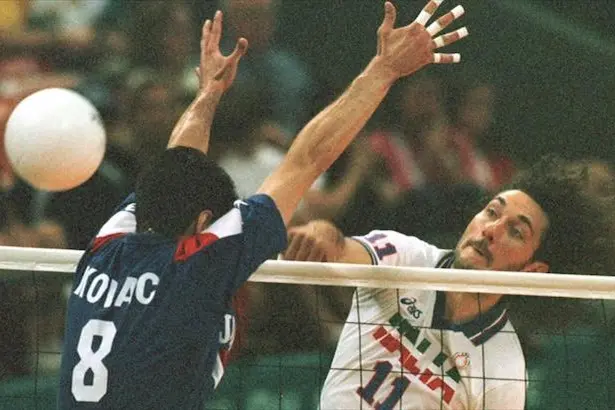
The photograph captures Zorzi in flight, suspended at the height of his sporting gift. The larger biography belongs to the person who had to land, live, change, and continue. That is why his story still matters.
LIFE IN CONTEXT / THE ROAD SO FAR
A life, one turning point at a time.
Follow the documented moments that shaped Andrea Zorzi — from the early years through defining personal and sporting milestones.
Born on 29 July in Noale, near Venice, Italy
Begins volleyball at sixteen after encouragement from a schoolteacher
Joins Parma and begins the club chapter that will lead to the 1990 Grand Slam
Debuts for Italy, beginning a 325-appearance national-team career
Represents Italy at the Seoul Olympic Games
Wins the European Championship with Italy
Wins the world championship in Brazil and the five-title Grand Slam with Parma; World League MVP
Named World League MVP again
Competes at the Barcelona Olympic Games
Wins the European Championship and World Grand Champions Cup
Wins a second world title in Athens; moves to Treviso
Wins the European Championship, FIVB World Cup and European Champions Cup with Treviso
Wins the Italian title with Treviso; earns Olympic silver in Atlanta
Retires from professional competition and begins a new public life
Receives the Fair Play Menarini international recognition
Debuts in La leggenda del pallavolista volante
Inducted into the International Volleyball Hall of Fame
Performs La magnifica imperfezione during the Italian federation's 80th-anniversary celebrations
Dates and life stages reflect the available sources. An undated childhood stage is not presented as an exact year.
WHAT THIS LIFE CAN TEACH US
Carry the story beyond the page.
- Look for an environment in which a characteristic that isolates you can become a source of connection and contribution.
- Build teams through mutual respect and shared work, not through the expectation that everyone must think or feel alike.
- Give effort its full dignity: a defeat can hurt without becoming a verdict on your worth.
- When a successful chapter loses its meaning, learning a new craft can be an act of courage rather than a retreat.
Reflections drawn from documented experiences; these are not quotations or personal advice from Andrea Zorzi.
THE SPORTING STORY
Career and achievements
Andrea Zorzi was born on 29 July 1965 in Noale, near Venice. The Italian volleyball championship would eventually know him as an opposite hitter whose timing, height and attacking range made him a formidable opponent. The road began in Padua, led through Parma's celebrated years, then Milan, Treviso and Macerata, where he ended his playing career in 1998.
With Parma, 1990 became a season of astonishing breadth. Under coach Gian Paolo Montali the team won the Italian championship, Italian Cup, European Cup Winners’ Cup, European Super Cup and Club World Championship: a rare sweep remembered as a Grand Slam. Treviso brought further honours after Zorzi joined in 1994, including the 1995 European Champions Cup and the Italian league title in 1996. No individual wins a five-trophy season alone: those victories belonged to organisations capable of combining elite talent with repeatable collective execution.
Italy's national team gave that principle a larger arena. Between 1986 and 1996 Zorzi wore the national jersey 325 times, competing at three Olympic Games: Seoul 1988, Barcelona 1992 and Atlanta 1996. Under Julio Velasco, Italy became world champion at Rio de Janeiro in 1990 after defeating Cuba in the final. In Athens in 1994 the team defended its crown, beating the Netherlands 3-1 and finishing with a remarkable 15-1 fourth set. The European titles came in 1989, 1993 and 1995; Italy also won the 1993 World Grand Champions Cup and 1995 World Cup. Zorzi was among the World League's outstanding individuals, earning MVP honours in 1990 and 1991.
Then came Atlanta. Italy had spent years setting standards that others tried to reach, but the Olympic final in 1996 went to the Netherlands. Zorzi left the Games with silver and a result that, by his later account, continued to matter across the decades. His place in volleyball history is not diminished by that result; it becomes more human when the defeat is included. The International Volleyball Hall of Fame inducted him in 2024, recognition of a career whose influence has travelled far beyond a medal count.
A teenager once embarrassed by his own height found a place where it could become a strength. He was sixteen when volleyball entered his life; years later, the world would know Andrea “Zorro” Zorzi as one of the most formidable attackers of Italy’s Generazione di Fenomeni. The numbers are immense: 325 appearances in blue, two world titles, three European crowns, three Olympic Games and silver at Atlanta 1996. But the story begins before the victories and continues long after the applause. Zorzi has spoken openly about the cost of relentless competition, the difficulty of defeat and the danger of dividing human beings into winners and losers. Athlete, teammate, storyteller and stage performer, he offers something more valuable than the fantasy of an invincible hero: the example of a person who learned to turn discomfort into belonging, excellence into shared work, and an ending into a new beginning.
How they changed their sport
The enduring lesson of Andrea Zorzi is not that greatness makes a person immune to doubt. His story demonstrates nearly the opposite. A physical characteristic he disliked helped him discover a community. The discipline of a great team turned an individual gift into shared achievement. The most painful defeat did not erase years of excellence. And when elite sport ceased to give him the same meaning, he did not insist on living forever as the man he had been.
His work as a journalist, educator and performer extends that journey. He has also warned against reducing sport or life to slogans about winning. This is the stronger kind of inspiration: not a command to become extraordinary at any cost, but an invitation to practise seriously, respect other people, accept complexity, and remain capable of changing. There is courage in the leap towards a new skill. There is dignity in the effort that produces no medal. There is still a life after the final whistle.
Sources and further reading
Official sports archive ↗Personal history and primary references
- International Volleyball Hall of Fame — Andrea Zorzi, Class of 2024
- Treccani — Andrea Zorzi: official biographical entry
- Fair Play Menarini — Zorzi's club and national-team chronology
- FIPAV — 1994: Italy's second world championship
- Fondazione ZOE — Zorzi as player, commentator and theatrical storyteller
- Corriere dello Sport — Zorzi on adolescence, teamwork and theatre, 2016
- Giffoni Sport — Zorzi on respect within a team, 2024
- Il Foglio — Zorzi on retirement and competitive identity, 2024
- Giffoni Sport — Zorzi speaks to young audiences, 2026
- FIPAV — La magnifica imperfezione, October 2026
- Il Dolomiti — Zorzi on the limits of winning and losing labels, 2026
These sources support the reported biographical details. Where several accounts differ, this independent editorial portrait uses only shared, verifiable facts.
Independent editorial coverage. This is not an official profile and does not imply endorsement, membership, representation, commercial involvement or partnership with Sportive Minds.