
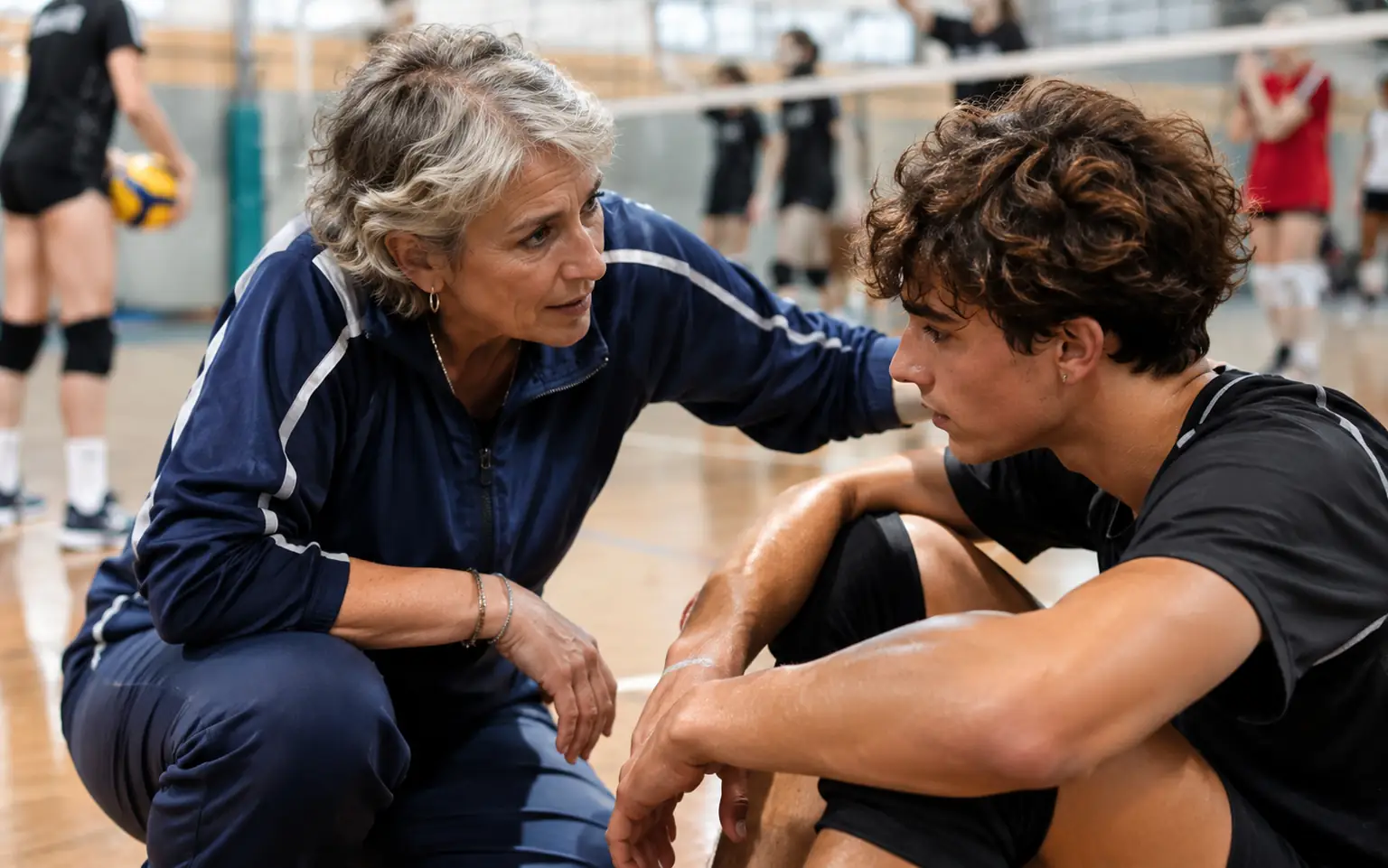
After the defeat, everyone hears the coach's voice. That voice can make the changing room smaller, turning every mistake into an accusation. Or it can open the room again: here is what happened, here is what we can learn, and here is how we prepare. The players will remember the result. They may remember the tone longer.
A coach's influence cannot be measured only in wins. It lives in the moments when an athlete is injured, left out, struggling to learn or unsure whether they still have a place in the group. Winning can conceal a poor culture. Losing exposes it. The real question is not whether a coach sets high standards; serious sport requires them. It is whether those standards challenge people without convincing them that one error can cost them their dignity.
Coaches are often the most influential adults outside the family in a young athlete’s life. They shape routines, expectations, feedback and the language athletes use to describe themselves. A coach can make a training session demanding and constructive, or demanding and humiliating. The outward workload may look similar while the psychological experience is very different.
Belonging is not a soft alternative to excellence. It can make learning, communication and sustained participation more possible. A team in which people are able to ask questions and report problems is better equipped to adapt. High standards work best when athletes understand their purpose and do not fear that a mistake will erase their value.
A team is a social system before it is a formation
A formation describes positions on a field. It does not describe who feels heard, who can ask for help, who is repeatedly blamed or who receives second chances. These patterns emerge through ordinary interactions: a coach’s response to a missed pass, the way substitutions are explained, the tone of a video review and the welcome given to a new player.
Every team develops unwritten rules. Some are useful: arrive on time, prepare equipment, respect teammates. Others are harmful: never admit fear, never question an instruction, never reveal an injury or uncertainty. These rules may be learned without ever being stated aloud.
Coaches can uncover the culture by listening as carefully as they observe performance. Which athletes speak freely? Who becomes silent after criticism? Do teammates support each other during difficult drills? Are humor and teasing used to include people or isolate them? The answers are not psychological diagnoses. They are clues about how people experience the environment.
Feedback should teach, not label
“Your positioning was late on that transition” is a description that can lead to learning. “You are lazy” is a judgment about character. The difference matters. A player can act on an observation, test an adjustment and see whether it works. A character label offers little guidance and can become part of the athlete’s self-image.
Specific feedback is not automatically gentle. A coach can be clear, urgent and demanding without humiliating someone. In high-pressure situations, short instructions often help more than a long emotional lecture. During analysis afterward, the coach has time to explain why a movement failed and what could change next time.
When feedback is delivered publicly, it shapes the whole group. Teammates observe whether mistakes lead to useful teaching or social punishment. A team that learns from errors can still compete ferociously. It simply understands that performance errors are information, not proof of personal worth.
Autonomy and structure belong together
An autonomy-supportive coaching style is sometimes mistaken for allowing athletes to do whatever they want. That is not the point. Structure remains essential: rules, clear boundaries, safety, planned progression and accountability. Autonomy support means helping athletes understand the reasons for tasks and giving meaningful choice where appropriate.
A 2025 study with youth athletes and coaches examined autonomy-supportive coaching in relation to resilience, optimism and athlete development. Its design does not establish a universal causal formula, but it contributes to a growing research conversation about how coaching relationships influence motivation and development.
A coach can explain why a difficult drill matters, ask an athlete which cue is most helpful or invite a team to reflect on a game plan. None of these actions diminishes expertise. They allow athletes to become active learners rather than passive recipients of commands. The goal is responsibility, not constant negotiation.
Belonging cannot depend on selection status
Teams often express solidarity while winning. The more revealing moment arrives when an athlete is injured, benched, transferred or left out of the match-day squad. Does that person still receive attention, information and respectful communication? Or do they disappear from the coach’s emotional map?
Not everyone can receive the same playing time. Competitive decisions may be painful and necessary. Fairness does not mean pretending all athletes currently perform identically. It means explaining criteria, avoiding arbitrary humiliation and offering a genuine development pathway where possible.
An athlete who understands why they were not selected may still be disappointed. But they are less likely to feel that the institution is denying their personhood. Coaches should resist making inclusion a reward for immediate usefulness. Belonging is strongest when people can experience it through difficult periods.
The coach's influence extends beyond the session
An athlete carries the team’s culture into the journey home, the classroom, friendships and self-talk. A harsh remark from a respected coach may continue repeating in a child’s mind after the adult has forgotten saying it. Equally, a precise moment of trust can become a reference point for years.
This power should not make coaches fearful of every word. It should encourage professional reflection. What do athletes learn from the way I react when tired? Do I correct mistakes differently depending on who made them? Do I mistake loudness for commitment or quietness for disengagement?
Supervision, mentoring and peer observation can help coaches examine blind spots. A successful coach is not someone who never needs feedback. It is someone who remains willing to learn, particularly when their authority makes others reluctant to challenge them.
Psychological safety and safeguarding are distinct obligations
A welcoming atmosphere is valuable but is not a substitute for formal safeguarding. Clubs need clear protection policies, reporting routes, appropriate boundaries and trained people who can respond to concerns. Vulnerable athletes and children should never be expected to rely only on a friendly relationship with the coach.
The International Olympic Committee’s mental-health guidance emphasizes the importance of training environments alongside individual care. Sport systems should not merely encourage struggling athletes to seek treatment while ignoring organizational conditions that contribute to distress.
Coaches must also know the limits of their role. They can listen and refer; they should not diagnose conditions outside their qualifications or promise secrecy when safeguarding rules require action. Respecting professional boundaries is part of good coaching.
Building a culture that survives defeat
Winning can hide problems. When results are positive, athletes may tolerate poor communication or unfair treatment because they fear disrupting momentum. A difficult season exposes the underlying relationships. Are expectations still understandable? Does blame become the dominant language? Do injured and reserve players remain included?
Useful teams separate the review of a performance from the evaluation of a person. They examine tactical decisions, workload, preparation and communication. They take responsibility across roles, including staff. They avoid reducing every complex result to the mentality of one young player.
A coach can model this by acknowledging mistakes. “I gave an unclear instruction” does not weaken authority; it demonstrates accountability. Athletes can learn that responsibility is compatible with dignity, even when the result hurts.
How belonging can be measured without turning it into surveillance
Clubs often measure attendance, training load and match statistics. They can also ask simple, voluntary questions about whether athletes understand their role, feel able to report a problem and know whom to approach with concerns. Responses should be collected with appropriate privacy, especially for minors.
Do not turn every conversation into a scorecard. Athletes need space to disagree without fearing consequences. Anonymous feedback may help if group size and handling protect identities. Staff should communicate what will happen to the information and what changes are realistically possible.
Qualitative signals can be equally useful: who stays involved after injury, how newcomers are introduced and whether former players speak positively about the experience. A culture cannot be reduced to a single number, but it can be examined and improved.
Ten small behaviors that make a large difference
- Learn and use athletes’ names accurately; avoid humiliating nicknames.
- Explain the purpose of challenging training rather than relying only on commands.
- Give feedback on observable actions, not fixed character traits.
- Discuss selection criteria before the last minute whenever possible.
- Include injured and reserve players in appropriate group activities.
- Provide a clear safeguarding route independent of the head coach.
- Ask athletes which feedback cues they find useful, while maintaining safety standards.
- Coordinate with qualified medical and psychological professionals when needed.
- Recognize teamwork and learning alongside results.
- Review your own communication after difficult competitions.
These habits do not replace technical knowledge. They make that knowledge more accessible to the humans expected to use it.
Excellence does not have to cost dignity
Sport can be intense. Coaches sometimes have seconds to make decisions, athletes must tolerate uncertainty and difficult feedback is unavoidable. None of that requires humiliation as a training method. A person can be challenged without being diminished.
The best coaches teach skills, tactical understanding and disciplined preparation. They also help create an environment where people can remain connected to the sport through success, failure and transitions. Their influence is measured not only by what athletes achieve under their guidance but by what they carry into the rest of their lives.
A championship belongs to a season. The experience of belonging can last much longer.
A practice session can reveal more than a match
Consider a youth team preparing for a difficult away fixture. The coach has planned a challenging drill in which defenders must make fast decisions under pressure. At first, errors are frequent. A coach focused only on eliminating mistakes may stop the activity repeatedly to criticize individuals. Another coach might pause to identify the decision that is causing the problem, demonstrate the desired cue and let athletes practice again.
Both coaches may care about winning. The difference lies in what the players are learning about errors and responsibility. In the second environment, the athlete receives an instruction they can test. In the first, they may learn that mistakes threaten their social standing, particularly if teammates witness humiliation. Over a season, repeated small interactions can shape willingness to ask questions and try new approaches.
This is not a claim that one feedback style guarantees victories. Competitive performance depends on many variables. It is a reminder that coaching methods affect the learning experience in ways that are not captured by the scoreboard. Quality should be measured in how athletes improve and whether they can participate responsibly in the process.
Fairness is not identical treatment
Athletes differ in age, experience, health, disability needs, language and personal circumstances. Treating everyone identically can feel fair but may ignore the conditions that make meaningful participation possible. A newcomer unfamiliar with a drill may need an explanation. An athlete returning after injury may require approved modifications. A child learning the training language may benefit from a demonstration rather than a shouted instruction.
Fairness begins with transparent expectations and appropriate adjustments, not arbitrary preference. Coaches should be able to explain why different athletes are assigned different roles or workloads. Adjustments must preserve safety and sporting integrity; they should not be disguised promises of selection or equal playing time.
Teams can communicate these principles early. A preseason conversation can distinguish nonnegotiable safety standards from flexible learning strategies. Athletes can then understand that different support does not automatically mean favoritism. When adults are consistent about the reasons behind decisions, trust is easier to maintain.
The reserve player is a cultural test
A player who begins every match can feel valued because performance creates frequent opportunities for recognition. A reserve player may receive less feedback, fewer meaningful practice opportunities and ambiguous information about progression. The team may still call itself a family, but that language rings hollow if some members are visible only when a starter is unavailable.
Coaches need honest conversations about roles. Nobody should promise playing time that cannot be guaranteed. Still, a person can understand how selections are made, what skills require improvement and which opportunities exist for development. If the current club cannot offer an appropriate pathway, a respectful introduction elsewhere may be more valuable than empty reassurance.
Watch how the team responds when substitutes contribute. Do teammates celebrate preparation and support, or only goals and public attention? The reserve player’s experience reveals whether belonging is a genuine commitment or a reward for sporting usefulness.
The relationship between culture and long-term participation
Children and adolescents may leave sport for many reasons: interests change, education becomes demanding, transport is difficult or the activity no longer fits their goals. A coach should not interpret every departure as evidence of a poor culture. Yet patterns of withdrawal deserve attention, especially when participants describe fear, humiliation or the absence of meaningful feedback.
Clubs can ask departing athletes what would have made participation easier. These conversations should be voluntary and should not become attempts to shame people into staying. Aggregated information may reveal scheduling barriers, uneven treatment or problems with communication that staff had overlooked.
Retention is not the only objective. An athlete can leave a team with a positive relationship with movement and compete happily elsewhere. A mature sporting organization values that outcome. The aim is to create an environment that people can remember with dignity, not to keep every player at any cost.
How to support a coach who is under pressure
Coaches are people too. They face expectations from directors, families, sponsors and athletes, often with limited time or pay. A coach working under chronic pressure may rely on familiar commands and miss signs that a player needs another approach. Organizations cannot solve this by instructing staff simply to be more empathetic.
Training, peer observation, mentoring and clear escalation procedures can give coaches practical support. Clubs should define reasonable communication expectations, including how parents raise concerns and when staff can be contacted. The coach should not be expected to act as a physiotherapist, therapist, social worker and administrator simultaneously.
A healthy system protects athletes and staff through clear professional boundaries. When difficult issues arise, the answer is not always a better speech. It may be more staff time, a trained safeguarding lead or appropriate specialist involvement.
A simple weekly culture review
At the end of a week, a coach can ask three questions. First: Did every athlete receive at least one piece of specific, useful feedback? Second: Did anyone become less willing to participate, and have we asked why without making assumptions? Third: When something went wrong, did our response make the next action clearer?
These are reflection prompts, not a validated clinical instrument or a numerical score. They help staff notice ordinary behavior before patterns become entrenched. A short written note can be more useful than a large survey that no one reads.
Teams can involve older athletes appropriately by asking which training instructions were clear and what support would help learning. Participation should be voluntary and respectful. Coaches retain responsibility for safety and technical decisions, but they can learn from the people experiencing their methods.
What a strong culture looks like on a bad day
Culture is easiest to praise after a win. A difficult day is the better test. The referee makes an unpopular decision, players become frustrated and the team loses. Afterward, the coach has choices: blame individuals, compare them publicly or help them understand what can be improved.
A valuable conversation can acknowledge genuine disappointment without turning the defeat into a statement about character. Athletes can take responsibility for decisions, while the coach considers preparation and instruction. The team does not need to pretend the match was enjoyable. It needs a way to move forward that preserves both standards and relationships.
The strongest legacy of a coach may be the habits athletes take elsewhere: asking good questions, respecting teammates, recovering after errors and remaining willing to learn. That legacy deserves attention alongside medals and trophies.
The five moments that reveal a coaching culture
Before selection: A coach can explain how decisions are made and what each athlete is being assessed against. This cannot eliminate disappointment, but it makes the process less arbitrary. Players should know what is expected and have a realistic route to feedback, including when they are not chosen for the starting team.
Immediately after a mistake: The coach can name the specific decision or technical movement that needs attention. A child who is told precisely what to practice has information; a child publicly called lazy or useless has only a threat to identity. Demanding standards and respectful correction can coexist.
When a star misbehaves: If the strongest player is excused for humiliating teammates, everyone learns that rules depend on status. Holding talented athletes to the same expectations reinforces trust and protects the group. The message is not that performance does not matter, but that performance never purchases permission to mistreat others.
During injury or emotional difficulty: Coaches should ask how the athlete wishes to remain connected while respecting medical guidance and individual circumstances. They should recognize the boundary between coaching, healthcare and psychological treatment. The athlete must not have to claim readiness merely to preserve a place in the group.
At the end of a season: A club can review more than rankings. Which athletes improved? Who stopped attending, and why? Did newcomers receive attention? Were concerns addressed? What did families and athletes say about safety and belonging? These questions invite a culture that learns from its own experience.
A team can still compete intensely. Indeed, a strong culture may make difficult training more sustainable because athletes understand why they are challenged and trust the adults who lead them. Respect does not replace excellence; it provides conditions in which people can pursue it without feeling that every error threatens their worth.
From the Legends archive: achievement as a collective story
Wilma Rudolph's Sportive Minds biography does not begin with three Olympic golds as if they were created by one person alone. It documents family care, a difficult path to treatment and the Tennessee State Tigerbelles training environment. Her achievements remain her own, but the wider story includes the adults and teammates who helped make serious opportunity possible.
That distinction is central to coaching. A professional can demand excellence while remembering that performance develops inside a network of relationships. If a child is not selected, The Athlete Nobody Picked explores how respectful feedback can preserve a route forward rather than ending someone's relationship with sport.
Evidence context and limits
Zhang, Du and Tao (2025) report an association between autonomy-supportive coaching and developmental measures in their observational sample. The IOC consensus (Reardon et al., 2026) discusses the wider mental-health environment. These sources inform, but do not certify, one universal coaching method.
Research and further reading
- Zhang, N., Du, G., & Tao, T. (2025, online). Empowering young athletes: The influence of autonomy-supportive coaching on resilience, optimism, and development. Frontiers in Psychology, 15, 1433171. DOI: 10.3389/fpsyg.2024.1433171. Observational association and mediation model; not a randomized causal trial. Original source
- Reardon, C. L., et al. (2026). Mental health in elite athletes: International Olympic Committee consensus statement (2026). British Journal of Sports Medicine, 60(15), 1083–1130. DOI: 10.1136/bjsports-2025-111514. Original source
- Reardon, C. L., et al. (2019). Mental health in elite athletes: International Olympic Committee consensus statement (2019). British Journal of Sports Medicine, 53(11), 667–699. DOI: 10.1136/bjsports-2019-100715. Original source
- World Health Organization (2020). WHO guidelines on physical activity and sedentary behaviour. Geneva: WHO. ISBN 978-92-4-001512-8. Original source
*Editorial note: This article synthesizes research and practical coaching principles. It does not imply that a single study proves any universal method of coaching.*
Editorial illustration using an original Sportive Minds photograph featuring fictional people; not documentary reporting or endorsement.