
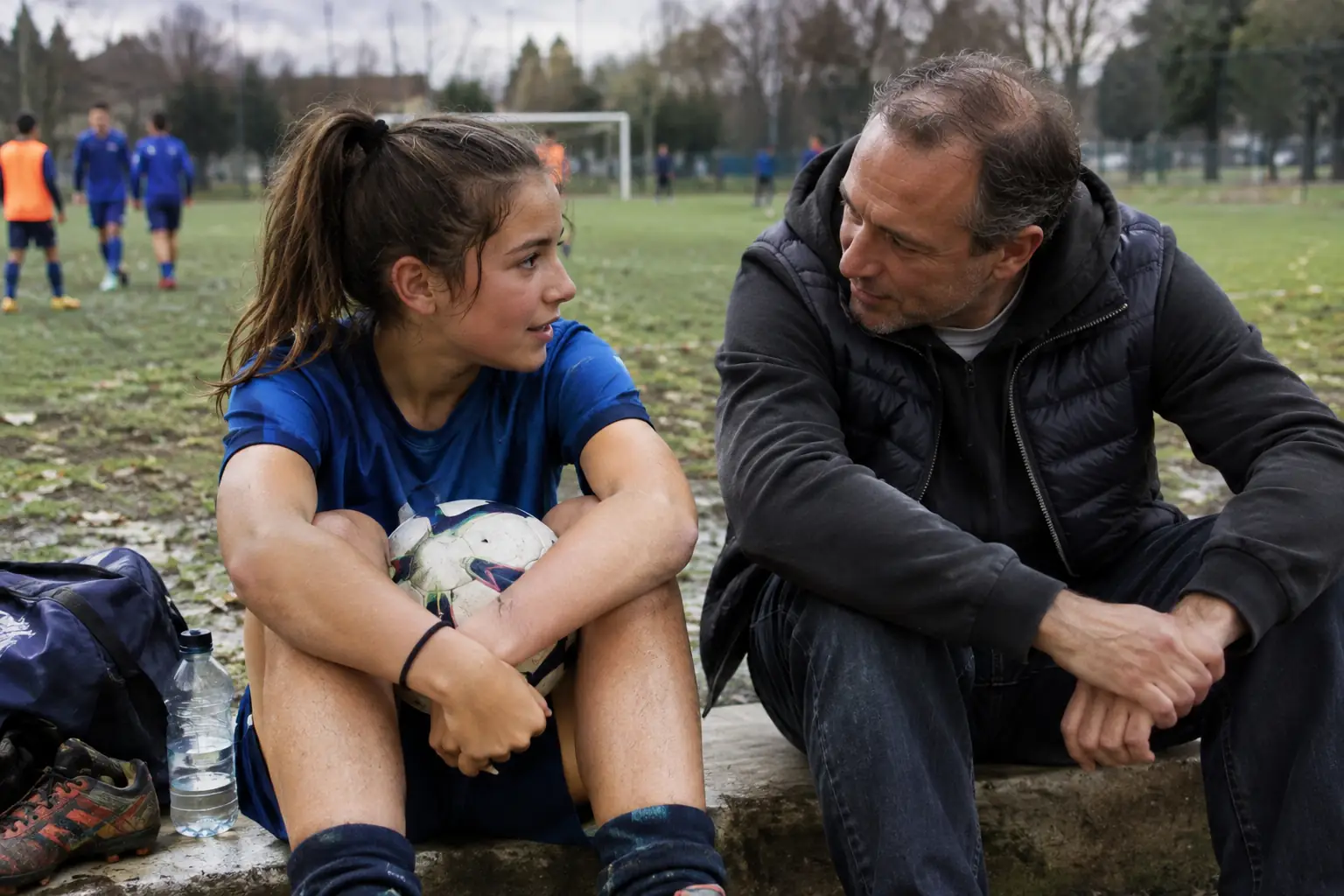
The match is over, but for the child it may not feel finished. They are heading toward the car with tired legs and a head full of what happened on the field. A parent is waiting, remembering the cost of travel, the missed chance and an apparently unfair substitution. The conversation that follows may be gentle, or it may become a second match in which the child is expected to explain every mistake.
Parents are not spectators in the practical sense. They arrange lifts, pay fees, give up weekends and worry about futures that nobody can guarantee. Their support is essential. Precisely because it matters so much, the boundary between care and pressure can be hard to see. The question worth asking is not whether parents should care less, but what helps a child feel supported after the scoreboard no longer matters.
Parents are essential to youth sport. They pay fees, arrange transport, provide meals, wash uniforms, encourage practice and help children manage everyday life. Their contribution is often invisible. Yet the same involvement that makes participation possible can become pressure when every conversation turns into a performance review.
The aim is not to demand that parents remain silent or indifferent. It is to understand how support can preserve a child’s motivation, independence and enjoyment while respecting the real responsibilities of family life. A good sporting parent does not need to know every tactical detail. They need to remain someone their child can turn to whether the result was wonderful or terrible.
The journey home can be more important than the scoreboard
For some children, the car ride after a match is a welcome moment of connection. For others, it becomes an unexpected second examination. A parent asks why they did not pass sooner, why they missed a shot or whether they listened to the coach. The adult may intend to help, but the child may hear that the day is not over until every mistake has been discussed.
Timing matters. Immediately after competition, athletes may be tired, disappointed or overstimulated. The most useful first response may be food, quiet, company or a simple question about whether they want to talk.
Parents can ask, “Would you like me to listen, or would you rather leave the match alone for now?” That does not prevent later reflection. It makes reflection a conversation rather than an obligation. The child learns that family connection does not depend on the next result.
Support is not the same as control
Research on youth athlete motivation emphasizes that parents influence sporting experiences in multiple ways. A 2024 systematic review of 29 studies, involving thousands of participants, identified autonomy-supportive parenting, positive relationships and moderate involvement among promising strategies. This does not establish one perfect parenting formula, but it challenges the assumption that more direction automatically means more motivation.
Support can mean helping a child prepare equipment or plan a training week. Control may begin when adults make every sporting decision, monitor every minute or prevent the athlete from expressing a different ambition. The same behavior can feel different depending on age, context and the child’s wishes.
Parents can gradually transfer appropriate responsibility: letting adolescents organize a kit bag, communicate respectfully with coaches or decide between suitable activities. Independence should increase with maturity and within safety boundaries. A child who learns to participate in decisions may develop a stronger sense that sport is genuinely theirs.
The hidden weight of family sacrifice
Youth sport can be expensive and time-consuming. Parents may spend weekends traveling, rearrange employment and give up other activities to support a promising athlete. It is natural to hope that such investments are worthwhile. Problems arise when a child becomes responsible for justifying the family’s sacrifice.
A parent might say, “We have spent so much on this season,” intending to explain a budget decision. The child may hear, “If you fail, you have wasted our money.” The emotional meaning depends on how these conversations unfold and on the child’s circumstances.
Families can separate financial planning from performance evaluation. Discuss budgets openly at an age-appropriate level, while making clear that affection and dignity are not conditional on selection. The Aspen Institute’s Project Play research illustrates how substantial costs can affect family access to sport; it should also prompt honest conversations about what households can sustainably support.
The role of the coach must remain clear
Parents often see aspects of a child that the coach does not: mood changes, fatigue, school pressures and private worries. Coaches see technical behavior, team dynamics and training responses. Both perspectives can be valuable, but conflict becomes more likely when responsibilities are unclear.
Clubs should set expectations about communication, selection queries, safeguarding and respectful spectator conduct. Parents should know whom to contact, when and about what. A concern about safety needs a different route from disagreement about playing time.
A good coach does not dismiss all parental input as interference. A good parent does not assume that private tactical criticism is the only form of involvement. Together, they can create an environment in which the athlete receives coherent messages and appropriate opportunities to speak.
When the parent becomes a spectator
The sideline can be emotionally intense. Adults care about their children and may react strongly to an unfair decision or rough challenge. But shouting instructions from multiple directions can confuse young players, especially when the messages conflict with the coach’s plan.
Spectator behavior also teaches children how to handle frustration. Insults directed at referees, opposing players or other families may contradict lessons about respect. Even when a complaint is legitimate, how it is expressed matters.
A supportive sideline does not require forced cheerfulness. Parents can celebrate effort, enjoy the game and raise concerns appropriately after the event. The athlete should not have to manage an adult’s anger while also trying to compete.
Expectations change as children grow
A young child may participate primarily for movement and friendship. An adolescent may become interested in serious competition or professional development. Another may decide that sport is an important hobby rather than a career. These pathways deserve different kinds of conversation.
Parents can revisit the athlete’s goals instead of assuming that a dream expressed at age nine remains unchanged at sixteen. “What do you enjoy most now?” and “What would you like to improve?” are open questions. They leave space for ambition without turning it into a family contract.
Changes of interest should not automatically be interpreted as laziness. They may reflect a new environment, fatigue, social experiences, changing priorities or a desire to try something else. A family can help a young person evaluate decisions thoughtfully rather than responding with guilt or panic.
The difficult moment: not being selected
Selection decisions can hurt parents as much as athletes. Adults may feel the outcome is unfair, fear lost opportunity or worry about how the child will cope. Their immediate reaction can shape the child’s interpretation.
Before challenging a decision, ask what the athlete wants and what facts are known. A respectful request for criteria or development feedback may be appropriate. Public confrontations and accusations against other children usually make the situation worse.
The child needs room to feel disappointed without being required to adopt the parent’s anger. The central message is that a selection decision concerns a sporting opportunity at a particular time; it is not a measurement of personal worth.
Injury changes the family dynamic
When a young athlete is injured, parents may become anxious about recovery, future opportunities and medical decisions. Repeated questions about timelines can communicate urgency even when the adult simply wants reassurance.
Families can support clinical care by organizing appointments, helping with practical routines and respecting the rehabilitation team’s guidance. They can also preserve normal family life through conversation and activities unrelated to sport.
Persistent distress should be addressed with qualified professionals. A parent is not expected to be the child’s physiotherapist and psychologist. They can be a reliable source of care while connecting the child with the appropriate people.
What children actually need to hear
No single sentence works for every family. Still, some messages preserve independence and safety: “I enjoyed watching you.” “I’m here if you want to talk.” “What did you find difficult?” “Would you like help planning the next session?” “You matter to us whether you win or lose.”
These are invitations rather than scripts to recite mechanically. The aim is to create a relationship in which sport can be discussed honestly without becoming the dominant measure of the child’s worth.
Parents should also be willing to apologize. If an adult reacts badly after a match, acknowledging the mistake can model responsibility. Children learn how to handle their own errors partly by watching how adults handle theirs.
A family agreement for a healthy season
- Agree how much time and money the household can realistically dedicate to sport.
- Let the athlete help set goals appropriate to their age and experience.
- Decide when technical discussion is welcome and when family time stays separate.
- Treat coaches and referees respectfully while using clear channels for legitimate concerns.
- Ask regularly about enjoyment, friendships, learning and recovery.
- Make medical and safeguarding concerns a priority over results.
- Give the child permission to explore other interests and possible pathways.
- Review the agreement as circumstances change rather than using one bad result as a crisis.
This approach protects parental energy as well as athletic experience. Families need sustainable routines, not a permanent state of competition-related alarm.
The person who remains when the season ends
Children may forget a particular score but remember the atmosphere surrounding it. They remember whether adults could celebrate without boasting, lose without humiliation and listen without immediately correcting. They remember who was present when their role on the team changed.
Parents cannot control every coach, opponent or result. They can influence the emotional meaning of sport within the family. That influence is significant precisely because the parent-child relationship is larger than any match.
The most valuable sentence a young athlete may hear after an ordinary, difficult day is also the simplest: “I’m glad we got to do this together.”
A hypothetical match-day conversation
Imagine a parent who has spent three hours driving to a tournament. Their child plays only a few minutes and returns to the car upset. The adult is disappointed as well. They could criticize the coach, ask the child to work harder or immediately analyze the selection decision. Each response would communicate something about what the parent believes matters most.
Another option is to acknowledge the disappointment and ask what the child wants. The parent can say that the day was difficult and that there will be time to think about next steps later. This does not mean ignoring an unfair situation. It means preventing a moment of frustration from becoming the only definition of the day.
If the athlete wants feedback, the family can agree to ask the coach respectfully about selection criteria and opportunities for development. If the child would rather rest, the parent can leave the conversation for another time. This hypothetical example shows how support and boundaries can coexist.
The relationship between money and expectations
Sports participation can involve significant family expenditure. A parent who pays for training, equipment and travel may understandably wonder what the household is receiving in return. The problem arises when the child feels personally responsible for converting those investments into results.
Families can separate two conversations. One concerns affordability: what can the household sustain and which opportunities offer genuine value? The other concerns the athlete’s experience: what are they learning, enjoying and finding difficult? When those conversations remain distinct, financial decisions are less likely to become emotional demands.
This approach also allows a family to change course without humiliation. If an expensive pathway no longer suits the athlete or the household, choosing a more sustainable option is not necessarily giving up. It may preserve a healthy relationship with sport.
Parents are not expected to be perfect
Advice to sporting parents can become another impossible standard. Adults are told to be enthusiastic but not intrusive, supportive but not demanding, confident but never emotional. Real life is messier. Parents may be tired, anxious about expenses or disappointed by decisions they do not understand.
The objective is not to perform ideal behavior at every moment. It is to recognize patterns, repair mistakes and maintain a relationship in which the child can speak honestly. When a parent shouts at a referee or gives unwanted criticism, an apology can be more useful than pretending it never happened.
Children learn about responsibility by watching how adults respond to their own errors. A calm acknowledgment of a mistake teaches that disappointment and accountability can coexist without shame.
How clubs can make parenting easier
Clubs have an important role in reducing conflict. They can explain selection principles before the season begins, publish schedules early, establish fair communication channels and make safeguarding information accessible. They can also encourage parents to focus sideline communication on support rather than conflicting tactical instructions.
Clear procedures protect coaches too. A coach should not have to answer emotionally charged questions immediately after every match. A designated conversation time can create space for more thoughtful feedback. Parents should know how urgent welfare concerns are escalated separately from routine sporting disagreements.
The club can also invite families to understand different developmental objectives. An under-twelve team may emphasize participation and skill learning, while an older competitive squad may have different selection requirements. Accurate information prevents many avoidable misunderstandings.
The child who wants a different future
A teenager may once have dreamed of becoming a professional athlete and later discover another interest. Parents who have invested heavily can find that transition difficult. The change may feel like a loss, even when the young person is making a thoughtful decision.
A useful discussion explores what the athlete values now: competition, friends, movement, academic work or another activity. Adults can help examine consequences without turning the choice into a test of loyalty. A child should not need to continue pursuing a career dream solely because others remember it.
Sport can remain meaningful in a different form. A person might play recreationally, coach younger children, officiate or simply enjoy being active. Those paths are legitimate and may preserve benefits that a rigid elite pathway would jeopardize.
Social media and the parental audience
Parents are often proud to share photographs and videos of their children’s sporting achievements. Public visibility, however, carries responsibilities. Young athletes may not want every mistake, injury or personal milestone posted online, and rules around children’s images and consent vary by context.
Families should ask what the young person is comfortable sharing and respect the club’s safeguarding policies. A highlight reel can be a joyful record, but it should not become a public report card or an invitation to criticize other children. Personal information about health, location or private family circumstances deserves particular care.
Good boundaries allow celebrations to remain celebrations rather than turning a child’s developing identity into a permanent digital portfolio.
A healthy season includes ordinary days
Most sporting life consists of routine practices, modest improvements, transport arrangements, friendships and occasional disappointments. Parents may focus on tournaments because they are the most visible events, but the everyday experience is where a child’s relationship with movement is built.
A parent can ask about a teammate, a new skill or a funny moment rather than opening every conversation with the score. They can recognize that the young person may value a day for reasons unrelated to performance. That curiosity creates room for the child’s own perspective.
When the season ends, the most valuable family memory may not be the final ranking. It may be the feeling that competition was something they shared, not an examination the child had to pass.
Six commitments that protect a young athlete's experience
Listen before evaluating. A child may want to celebrate, complain, remain quiet or think about something unrelated to sport after a match. Parents can ask whether a conversation would be useful rather than assuming that every journey home requires technical analysis.
Respect the athlete's voice. Families manage money, transport and safety, but young people should have age-appropriate influence over their own goals. Ambition can be supported without turning a parent's dream into the child's obligation.
Keep costs visible. Financial sacrifice can create pressure even when adults never intend it. A realistic family budget and honest discussion of what participation requires can reduce the risk that a child feels responsible for repaying every expense through results.
Let coaches coach. Parents can ask about communication, safety and development, but constant sideline instruction may conflict with the coach's work and confuse the athlete. Serious safeguarding concerns are different and should be reported promptly.
Make room for changing interests. A teenager who wants a recreational route, a break or another sport deserves a thoughtful conversation, not an immediate accusation of giving up. Development includes learning what activities are meaningful and sustainable.
Protect the family relationship. Wins, injuries, selection and setbacks will change. A child's confidence in the people who care for them should not depend on a scoreboard. Encouragement is most credible when it remains present during disappointment.
These commitments do not promise that competitive sport will become easy. They make it more likely that young athletes can confront difficulty with support rather than fear. A family that values both commitment and autonomy helps the child learn lessons that can remain useful long after the sporting season ends.
A relationship bigger than one season
Parents often remember the moments when their child won, made a team or overcame a setback. The child may remember who was present when the experience became difficult. A dependable family relationship gives young athletes a place where they need not perform to earn approval. This does not eliminate responsibility or effort. It makes responsibility easier to sustain because the child knows that sport is an activity shared with supportive adults, not a permanent examination of personal worth.
The most durable lesson may be that a child is more important than the competition. Sporting ambition deserves respect, but so do changing interests, disappointment and the need to rest. A supportive family makes room for all of them.
From the Legends archive: family support before the finish line
Wilma Rudolph's life story includes her mother's efforts to obtain medical treatment and the part her family played during childhood rehabilitation. It is not a story about the perfect sports parent, nor a formula that families must imitate. It is an example of how sustained practical care can shape an athlete's opportunities long before a race becomes famous.
For families navigating disappointment and selection, The Athlete Nobody Picked offers another perspective: the parent-child relationship should be larger than a single sporting judgment.
Evidence context and limits
Gao et al. (2024) systematically reviewed parental roles in young-athlete motivation. Nicaise and Lienhart (2025) found associations between perceived parental pressure and adolescent burnout; their cross-sectional design cannot establish causation. Hellborg and Hedenborg (2024) is an editorial overview, not a systematic review.
Research and further reading
- Gao, Z., Chee, C. S., Wazir, M. R. N. W., Wang, J., Zheng, X., & Wang, T. (2024, online; 2023 collection). The role of parents in the motivation of young athletes: A systematic review. Frontiers in Psychology, 14, 1291711. DOI: 10.3389/fpsyg.2023.1291711. Original source
- Nicaise, V., & Lienhart, N. (2025). Is the perception of the frequency of use of parental pressure and directive behaviors related to elite adolescent athletes' burnout, emotions, and motivation? European Journal of Sport Science, 25(11), e70034. DOI: 10.1002/ejsc.70034. Cross-sectional associations; not causal proof. Original source
- Hellborg, A. M., & Hedenborg, S. (2024). Sport and parenthood. Sport in Society, editorial introduction. DOI: 10.1080/17430437.2024.2363888. Commentary; not an experimental study. Original source
- Solomon, J. (3 March 2025). Project Play survey: Family spending on youth sports rises 46% over five years. Aspen Institute, Project Play. United States family survey. Original source
*Editorial note: Illustrative examples are not real identifiable families. The article offers general educational guidance, not individualized psychological, medical or legal advice.*
Editorial illustration using an original Sportive Minds photograph featuring fictional people; not documentary reporting or endorsement.